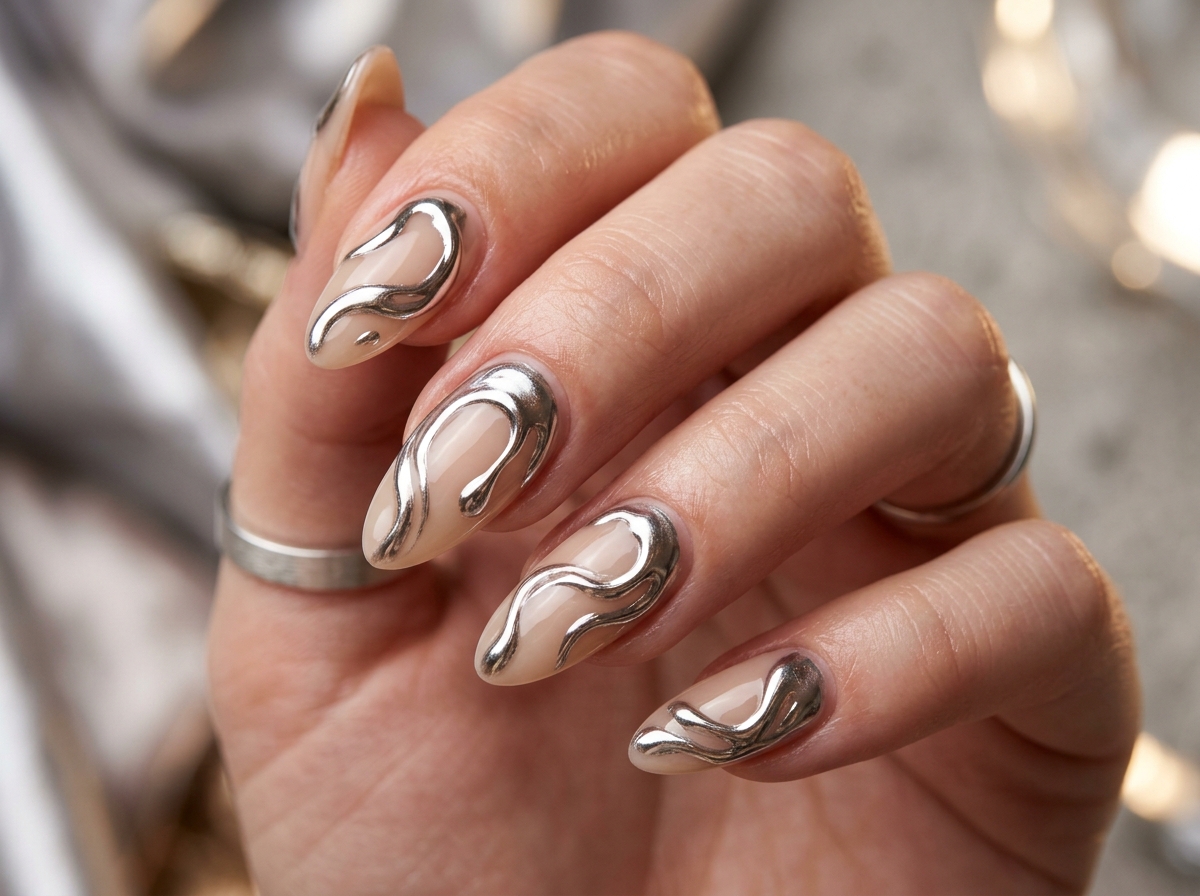
Molten Liquid Chrome Nails: How to Apply and Seal Mirror Finishes
Quick Answer (Application Protocol)
Molten liquid chrome nails are achieved by burnishing ultra-fine synthetic mica powder onto a freshly cured, warm non-wipe topcoat (cured for 25–30 seconds). To prevent edge chipping and cloudiness, excess powder is dusted off, free edges are sealed with non-acid primer, and the chrome layer is encapsulated with a thin builder gel sandwich before the final topcoat.
Key Takeaways
- The 30-Second Cure Window: Over-curing makes topcoat slick and repels chrome; under-curing leaves sticky smears.
- Silicone Tool Burnishing: Rubbing with a soft silicone applicator delivers higher specular reflection than foam eyeshadow wands.
- The Builder Gel Sandwich: A thin clear builder overlay locks inorganic chrome flakes between cross-linked polymer matrices.
- Edge Buffing Secret: Lightly filing the free edge with a 240-grit buffer creates a clean adhesion perimeter.
From Glazed Donuts to 2026 Molten Platinum
While 2022–2023 popularized pearlescent white "glazed" nails, 2026 manicures have shifted toward high-contrast, futuristic molten metals. Runway and studio looks now favor architectural platinum, molten mercury drips, and liquid bronze frames sculpted over nude negative space.
The Professional 6-Step Molten Chrome Protocol
- Black or Nude Base: Apply 2 thin coats of deep black gel (for mirror silver/gold) or sheer nude (for fairy chrome) and cure fully for 60s.
- Non-Wipe Topcoat Flash-Cure: Apply an ultra-thin non-wipe topcoat and cure for exactly 25 to 30 seconds under 36W LED.
- Mirror Burnishing: Immediately pick up a small amount of chrome powder on a silicone applicator and firmly rub the surface in circular motions until 100% specular reflection is achieved.
- Dusting Off Excess: Use an ultra-soft makeup dust brush to sweep away all loose powder flakes. Any loose dust left on the nail causes topcoat cloudiness.
- Free Edge Prep: Take a 240-grit buffer and gently swipe the free edge at a 45-degree angle to remove chrome powder from the very tip, exposing a 0.2mm gel anchor zone.
- Builder Sandwich & Final Topcoat: Paint a thin layer of clear builder base over the chrome and cap the free edge. Cure 30s, then finish with a heavy diamond topcoat for 60s.
Chrome Troubleshooting Guide
| Problem | Root Cause | Immediate Solution |
|---|---|---|
| Chrome looks glittery instead of liquid | Topcoat was over-cured or powder particle size is too coarse | Reduce LED curing time to 25s; use sub-micron milled chrome powder |
| Chrome peels off like a sheet in 3 days | No builder gel sandwich; free edge wasn't capped | Buff 0.2mm off the free edge before topcoating to create anchor points |
| Topcoat turns dull or gray | Loose powder mixed into topcoat bottle | Dust thoroughly; dedicate a separate topcoat bottle for chrome art |
Frequently Asked Questions
Why do my chrome nails chip or peel off quickly?
Chrome powders are inorganic metallic flakes. Without a builder gel sandwich and proper free-edge buffing, topcoats cannot adhere directly to the powder.
How long should you cure topcoat before applying chrome?
Cure non-wipe topcoat for 25 to 30 seconds under 36W LED—just enough to be tack-free while warm enough to grip the powder.
Related NAILYZA Guides
- Pillar Hub: Chrome & 3D Nail Art Collection →
- Sculpting Guide: Architectural 3D Nail Art: Sculpting Glass Dewdrops →
- Minimalist Styling: The Quiet Luxury Manicure: Micro-French in Liquid Metal →
- Nail Health Foundation: Rubber Base vs Hard Gel: Protecting Natural Nails →